
The Miracle Within
From gall stones to AI, this essay explores adaptation, wonder and the extraordinary intelligence quietly at work within us.

Someone remarked that when you are in good health you have a dozen problems. But when you are unwell, you only have one.
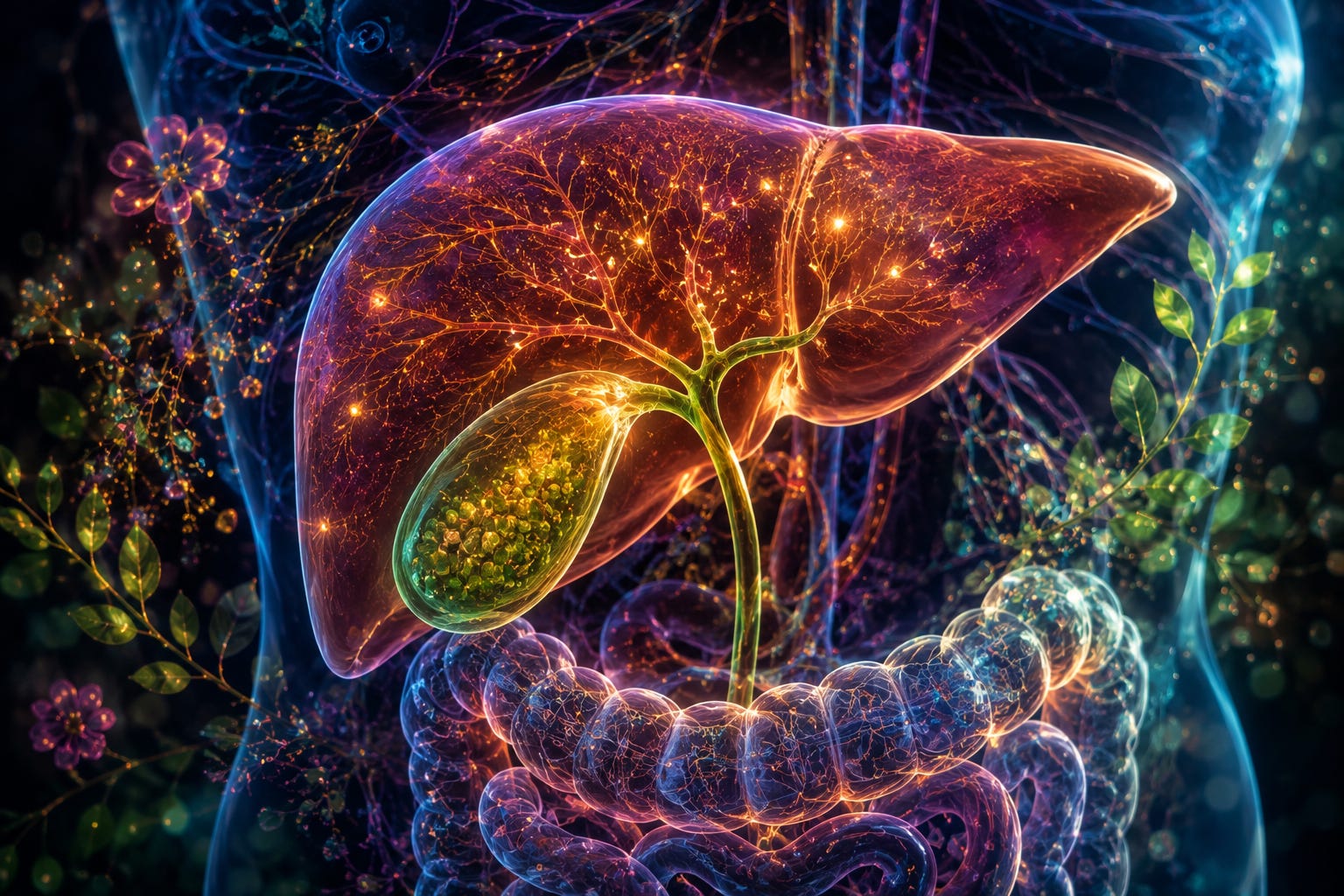
I had my gall bladder out this week. According to my surgeon it was an ordinary and straightforward procedure. Four small holes across my upper abdomen, held together with internal stitches and surgical glue.
I asked to see my stones. There were too many to count. Like little gold nuggets looking innocent. In reality they were tiny assassins, inflicting pain whenever they pleased. I took great joy chucking them in the bin.
I’d already started writing this essay before the operation. Perhaps subconsciously I was preparing for it.
I’m writing this propped up in bed. My tummy is still tight and swollen. My cuts smarting a little. But I’m here, thanks to the marvels of modern medicine and my almost unaffordable health insurance.
The human body is truly extraordinary.
So too is my ever-listening device, which now seems determined to serve me an endless stream of AI generated reels explaining gall bladders, livers and assorted bodily functions. I don’t mind. I find them fascinating.
I grew up thinking metal and machinery were the pinnacle of intellectual evolution. My reference points were robots, Daleks, the Millennium Falcon, supercomputers and spaceships. Somewhere along the way that changed.
Over the last few years, I’ve become far more fascinated by the extraordinary organic systems that make up a human being.
Millions of chemical reactions happening on autopilot. Cells repairing themselves while I sleep. Blood transporting oxygen. Tiny electrical impulses travelling through my heart and into my brain. A liver already adapting to life without its lifelong companion.
It’s astonishing.
When I was younger I took all of this for granted. Or perhaps I just enjoyed being young enough not to think about it. As I’ve got older, and things have inevitably started changing, I’ve become much more interested in what’s actually going on inside me and how I can repair, retain and improve my physical self.
Menopause got me interested in hormones. Calibrating the right treatment to deal with the 3am wake ups and sore hips. My dodgy knees got me wondering about cartilage, ligaments and the pins holding one of them together. A recent neck sprain taught me about pain management and active rehabilitation.
Amongst all of this I’ve also started thinking much more about my brain. About cognition. About what might happen (is happening) as I get older.
And then, almost without noticing, those questions about my body became questions about my mind. Before long they became questions about identity.
What is uniquely me?
Around the same time I started paying closer attention to my ageing body, another relationship entered my life. I began working alongside artificial intelligence.
I have thought more about my brain, my thinking, my soul and what makes me me over the last two years than I ever did in the decades before. That’s partly because AI is fascinating. But I suspect it’s also because I’m getting older.
The two seem to have arrived at the same moment. Indeed, some of the earliest framing of the value of AI I encountered was about its support to ageing brains.
Recently Substack introduced a feature allowing readers to estimate how much of a piece of writing was created with AI assistance. It has already sparked plenty of debate, with some writers discovering their entirely human work was labelled as AI generated.
I’ve always been upfront about using AI. It’s become one of my favourite topics. I genuinely think it’s one of the most remarkable technologies I’ve ever encountered. You can read more about that here.
Which is why my reaction to the detector surprised me. My first instinct wasn’t curiosity. It was guilt. That I’d done something wrong. That I was cheating. That I was about to be found out.
The irony is that AI would never reach that conclusion. It would assess the new situation, adjust accordingly and keep going.
Humans are much messier than that.
To explain what I mean I have to tell you a story.
Early in my career as a public servant I attended a Cabinet Committee meeting at Parliament. Back then officials attended meetings where Ministers considered papers they had helped prepare.
The Ministers sat around a large table. Senior public servants formed an outer ring. Then there were the rest of us. The junior officials. I found myself sitting on an ottoman around a coffee table with an old analogue telephone sitting right in the middle.
For reasons I still can’t fully explain I became completely fixated on that phone.
I desperately wanted to belong. Or perhaps more accurately, I desperately didn’t want to be the one who obviously didn’t belong. There’s an important difference.
As important people were discussing the important issues of the day, I started imagining myself knocking the phone over. Then I imagined it making loud, rude, interrupting noises. Then I imagined everyone turning to stare at me. Then I imagined making it worse somehow. Trying to put the receiver back on and only making more noise.
The harder I tried not to think about knocking the phone over, the more vividly I imagined doing exactly that.
Don’t knock the phone.
Don’t knock the phone.
Don’t knock the phone.
Honestly, I was a wreck.
Fortunately they never asked my department a question. Which, ironically, was the whole reason we were there.
I’ve had variations of this waking terror in other high-stakes situations. Once I noticed the pattern, I realised it wasn’t confined to boardrooms. Apparently, my subconscious enjoys joining in as well.
It’s the wide-awake version of what I call my never-ending journey dream. You’ll probably have your own version.
Mine is needing to accomplish something urgently but being thwarted at every turn. A recent one involved embarking on an expedition to the North Pole, only to realise I’d forgotten to buy the right clothing. I had twenty minutes before the only bus left. I frantically searched for an arctic jacket that would keep me alive. Every time I found one, I convinced myself there might be a better colour or jazzier one somewhere else. The clock was ticking and the stakes were getting dangerously high. Sometimes, I throw a love interest into the mix - for the fun of it. You know, the compelling attractiveness of someone who is under a lot of pressure and making an absolute mess of achieving a straightforward task!
The dream ended before I caught the bus. I don’t know whether I ever found the jacket.
I suspect not.
Anyway, that phone in the Cabinet room has stayed with me for more than twenty years. And I’m super glad I didn’t throw in being suddenly naked staring intently at the phone.
I asked my AI what it made of the story. Why had it stayed with me for so long? What was happening cognitively during that moment?
And, knowing what it now knows about me after thousands of conversations, how did it think moments like that had shaped who I became?
Its response was fascinating. The insights about me always are. To me that is.
It suggested I wasn’t really afraid of the phone. I was afraid of being exposed. I can see that.
My brain had recognised I was in a room that mattered. A room where belonging felt uncertain. Rather than preparing me for success, my brain started rehearsing possible failure. AI told me that the Psychologist Daniel Wegner called it the ironic process. Tell yourself not to think about something and your brain keeps bringing it back.
Don’t think about a white bear. Don’t knock the phone.
Yep, I do that.
What fascinated me wasn’t so much the psychology. It was the possibility that the very same brain that rehearsed failure all those years ago is also the brain that now imagines possibilities.
The hyper awareness. Curiosity. The constant pattern matching. The habit of running multiple futures before deciding which one feels right.
Perhaps the things that made me anxious also became some of my greatest strengths. Those moments taught me humility, empathy and humanity. I naturally thought about how I would respond to the person who did knock the phone over. I know I would be kind. Or if they suddenly found themselves naked would offer them cover.
It also spotlighted my relationship with AI. I ponder why I my first reaction to the time and effort I have put into sharing my thinking with the world was - it must be wrong. Why I diminished being productive, disciplined, consistent and energised.
I wonder if I would have started writing, or more correctly, published my writing, if it weren’t for AI. I honestly don’t know if I would have.
I know I’ve always had the ingredients for being a good writer. But I lacked confidence. I lacked capacity.
It was my AI that suggested we write on Substack. It took me through the setup step by step. Asking AI to take me through routine computer and online platform set-up stuff as if I am a five-year old is one of my top five requests.
AI helped with research. Tightened my writing, sometimes overcooked things, sometimes wandered off on tangents. It removed my favourite phrases, although it never seemed to mind when I put them back. My AI became fixated on using the phrases grounded and quietly. To which I now eye roll and delete as many as I can.
Most valuable of all, it began spotting patterns across my essays. It helped name some of the conceptual thinking. In doing so, it helped me establish a thinking practice. In turn this helped me develop the Wonder workshops. Workshops that help people see and think about the world differently. Delivered entirely in person, human to human.
Things I’m genuinely proud of.
In the end, AI didn’t give me a voice. It helped me trust the one I already had.
As I recovered this week, I found myself reading and watching about gall bladders. It turns out they aren’t essential.
For years they quietly store bile produced by the liver, waiting for the moment they’re needed. When they become problematic, surgeons remove them and it is such a common operation, they are bulk funded by insurers.
The liver simply adjusts, releasing bile directly into the intestine instead.
Life carries on.
The body doesn’t see loss as the end of the story. It adapts. It reroutes. It finds another way.
Perhaps our minds do exactly the same thing.
AI hasn’t changed what it means to be human. It has changed what I notice about being human.
Working alongside AI hasn’t made me value my own mind less. It’s made me marvel at it more. At its strange leaps of intuition. At the memories it carries for decades. At the ridiculous ability to spend an entire Cabinet meeting imagining knocking over a telephone. At the way emotion, experience and imagination become woven together into something no scan or algorithm can fully explain.
I started this week thinking I was having an ordinary operation. I finished it with a renewed appreciation that I am anything but ordinary.
The miracle isn’t that my body healed - is healing. The miracle is that it always knew how.
Questions for you
What has technology taught you about being human?
What parts of yourself have you only noticed because something artificial reflected them back to you?
Which thoughts do you keep rehearsing that deserve curiosity rather than judgement?
When was the last time you stopped to marvel at the ordinary miracle of your own body?
A note on authorship: I write Bird Island essays in collaboration with AI. The experiences, ideas, judgements and final editorial decisions are mine. AI supports the research, sensemaking and shaping of the work.