
Practising Possibility
On wonder, agency, and the ideas that organise themselves into worlds.

I’ve been thinking recently about how creative projects begin. Not the polished version people see at the end. I mean the beginning.
The moment where an idea starts gathering energy. What it takes to move from abstract ideas to a concrete, delivered thing.
I think about this a lot because I’ve realised over time that my approach to projects is deeply connected to how I grew up. We didn’t have a lot when I was young.
That was about money, but it was also a time with no internet and only two television channels. Looking back now, I think scarcity shaped my imagination in a very particular way.
When you don’t have access to everything, you learn to build worlds from fragments. You become resourceful with possibility. You entertain yourself through wondering. You stare at ordinary things for longer. You rearrange spaces in your imagination. You imagine alternatives because imagining is free.
Recently I heard a clip from Celeste, the founder of Studio C, talking about how boredom used to play a much bigger role in creativity. That resonated.
Boredom, and adjacent to that, the absence or limiting of stimulation, can be fertile soil for innovation. Undoubtedly AI and other technologies have increased productivity, but with that can also come cognitive overload and overstimulation.
I’m contracting at the moment and it often feels like I need to be switched on and operating at full capacity for clients at all times. Sometimes I miss the quieter parts of full time work. Doing budgets. Cleaning up files. Productive work, but not cognitively relentless.
I spent a lot of time thinking as a kid. Making things up. I still do it now. I walk into spaces all the time and instinctively think: What could this become?
Not because I’m trying to optimise everything. But because possibility has become a reflex. Increasingly, I think this is an important skill in creative work, leadership, and innovation.
The ability to perceive alternatives. To look at something fixed and imagine it differently.
At Bird Island we’ve talked before about “restoring sight-lines”. Relearning how to notice possibility after routine, systems, certainty, and exhaustion have narrowed our view of the world.
Wonder matters because it interrupts inevitability. It reminds us that things are not as fixed as they appear. That mindset has shaped almost every major project I’ve ever led.
One example was during my time leading public programming for He Tohu at the National Library of New Zealand.
He Tohu is one of New Zealand’s most significant constitutional exhibitions. It houses:
• Te Tiriti o Waitangi
• He Whakaputanga, the Declaration of Independence
• the Women’s Suffrage Petition
At the time it was presented, the Suffrage Petition stretched more than 270 metres long and represented a direct request from women to an all male Parliament.
Our team was responsible not only for tours and engagement, but for creating public programming that helped audiences connect emotionally and intellectually with the material.
I remember reflecting on the suffrage petition and one idea stayed with me constantly: the right to vote was fundamentally about agency.
The right to have a say.
The right to shape the future of the country.
The right to participate in authorship.
That framing opened something creatively. Once you begin thinking about agency, you begin noticing all the places where agency is still contested, constrained, or unequally distributed. And that became the beginning of an idea.
At this point in projects, I often start looking for what I call the “galvanising concept.” It’s probably a clumsy phrase, but I’ve never found a better one.
The galvanising concept is the organising intelligence of a project. The idea that suddenly gives energy and coherence to scattered thoughts.
Projects have parameters: a budget, a target audience, delivery goals, operational constraints. These help establish the area you are playing in.
But delivering a meaningful experience requires more than logistics. It requires a point of view. A tension. A concept capable of pulling fragments into orbit around something meaningful.
Eventually, if you stay with the process long enough, something starts gathering gravity.
Working collectively with others, through conversations, testing, and shared reflection, that concept eventually became:
Tapu.
What is sacred?
What remains sacred?
What have women historically been told to hide, suppress, or carry silently?
Suddenly the project had coherence. Once it had gravity, ideas started attaching themselves to it. We thought about seasons, time, cycles, the Maramataka, visibility, silence, embodiment, and power.
Our first symposium became: Te Awa Atua, the sacred river. We centred it around menstruation. It was incredible.
The response showed us that we had tapped into something much deeper than an event programme. We had created a space where people could connect cultural knowledge, identity, embodiment, history, and contemporary experience through a single organising idea.
The following year we expanded the Tapu concept into conversations around moko kauae and wāhine Māori identity.
Many Māori women navigating colonial society were pressured to suppress aspects of cultural identity, including moko kauae, in order to participate within systems shaped by European expectations of respectability and legitimacy.
That event also sold out.
Later we explored wāhine toa and atua wāhine through the extraordinary work of Robyn Kahukiwa and Patricia Grace. Women selected atua represented in the work and recorded personal reflections and stories connected to them.
Looking back now, I realise we were not just creating events. We were building conceptual worlds.
I think this is something many people misunderstand about creative work. The concept is not decoration. It is the organising intelligence.
Strong creative projects are rarely built from isolated ideas. More often they emerge through synthesis. A conversation. A memory. A cultural tension. A fragment resurfacing at exactly the right time.
Elizabeth Gilbert writes in Big Magic about inspiration almost like a living thing. A muse searching for receptive minds. Her argument is that ideas need to be nurtured and acted upon, otherwise they may drift elsewhere in search of more fertile ground.
I’ve always loved that idea.
Not because I think creativity belongs only to certain people, but because it suggests inspiration is participatory. That ideas are constantly moving through the world, looking for people willing to notice them, shape them, and bring them to life.
In The Alchemist, Paulo Coelho writes about moments of possibility existing around us every day. Small openings. Tiny locks waiting to be turned. Often we simply do not notice them.
Perhaps that is what practising possibility really is. Learning how to stay open long enough for inspiration to land. To follow the thread before certainty fully exists. To let scattered fragments slowly organise themselves into meaning. But also knowing that inspiration is abundant, quite possibly infinite. So, don’t worry if you missed possibility today, run with the next possibility tomorrow.
Ngā mihi
Glossary
Atua
Often understood as spiritual beings, ancestors, or deities.
Atua wāhine
Female atua or feminine spiritual archetypes.
He Tohu
A permanent constitutional exhibition at the National Library of New Zealand housing foundational documents including Te Tiriti o Waitangi, He Whakaputanga, and the Women’s Suffrage Petition.
He Whakaputanga
The 1835 Declaration of Independence of the United Tribes of New Zealand.
Maramataka
A traditional Māori lunar calendar and environmental knowledge system connected to cycles, seasons, and human activity.
Moko kauae
Traditional facial markings worn by wāhine Māori.
Tapu
Often understood as sacred, restricted, protected, or spiritually significant.
Te Awa Atua
“The sacred river.”
Te Tiriti o Waitangi
The Māori language version of the Treaty of Waitangi, signed in 1840 between Māori rangatira and the British Crown.
Wāhine Māori
Māori women.
Wāhine toa
Strong, courageous, or influential women.
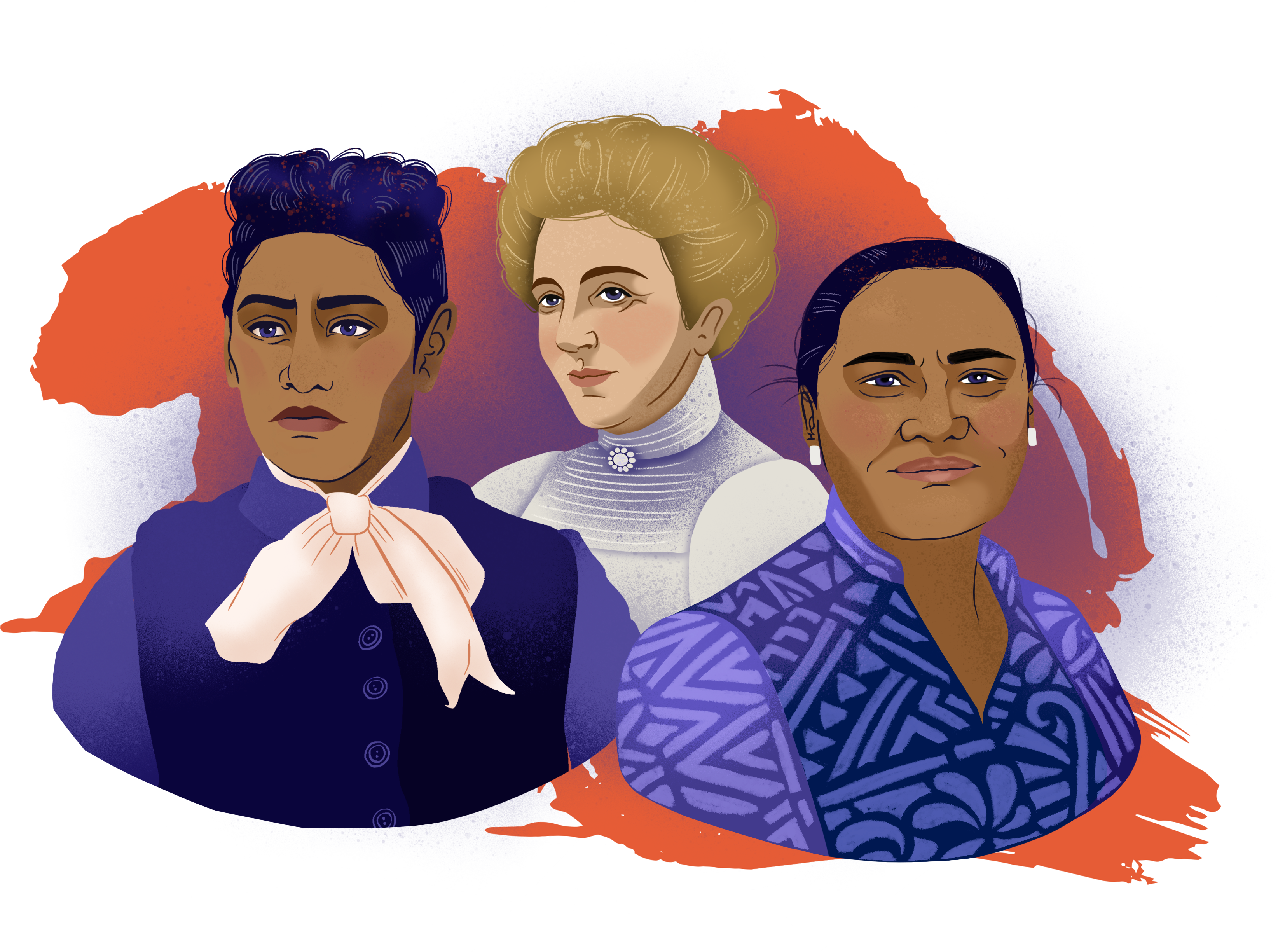
Image - Journey to Pay Equity, National Library of New Zealand.
Another engaging read with multiple threads like James Altucher's recommendation to practice generating and writing down ideas every day and the wonder potential of the adjacent possible